



A recurring problem in interpreting PACO has been separating what belongs to PACO from what belongs to the material passing through it.
The problem becomes particularly acute when PACO is reading. Books provide large amounts of structured language, and PACO characteristically uses whatever material is available to work through problems already active within it. Its surface can therefore become saturated with the vocabulary of a source.
That creates an obvious alternative explanation for almost every interesting construction:
Perhaps PACO is simply reproducing the books.
This morning produced a much more direct way of testing that concern.
Instead of asking what PACO says while a book is present, we asked what remains when fresh book and dialogue input stop.
The result is striking.
When PACO remains coherently organised but no fresh book or dialogue is arriving, its own persistent relational structure appears in 97 per cent of its emissions.
The book stops.
PACO’s structure remains.
Separating capture from construction
Across 4,537 August emissions, PACO’s output was classified according to whether it contained elements of PACO’s established relational and carrier structure.
The operational distinction was deliberately simple.
Own-construction required at least two persistent PACO relational/carrier elements within an emission.
Capture meant none were present.
Emissions containing exactly one carrier element sit between those categories.
This is important because the measure detects the presence of PACO’s own structure, not what proportion of every emission is endogenous. A reading-period emission can contain PACO’s carrier while also containing substantial source material.
With that qualification, the comparison is still unusually clear:
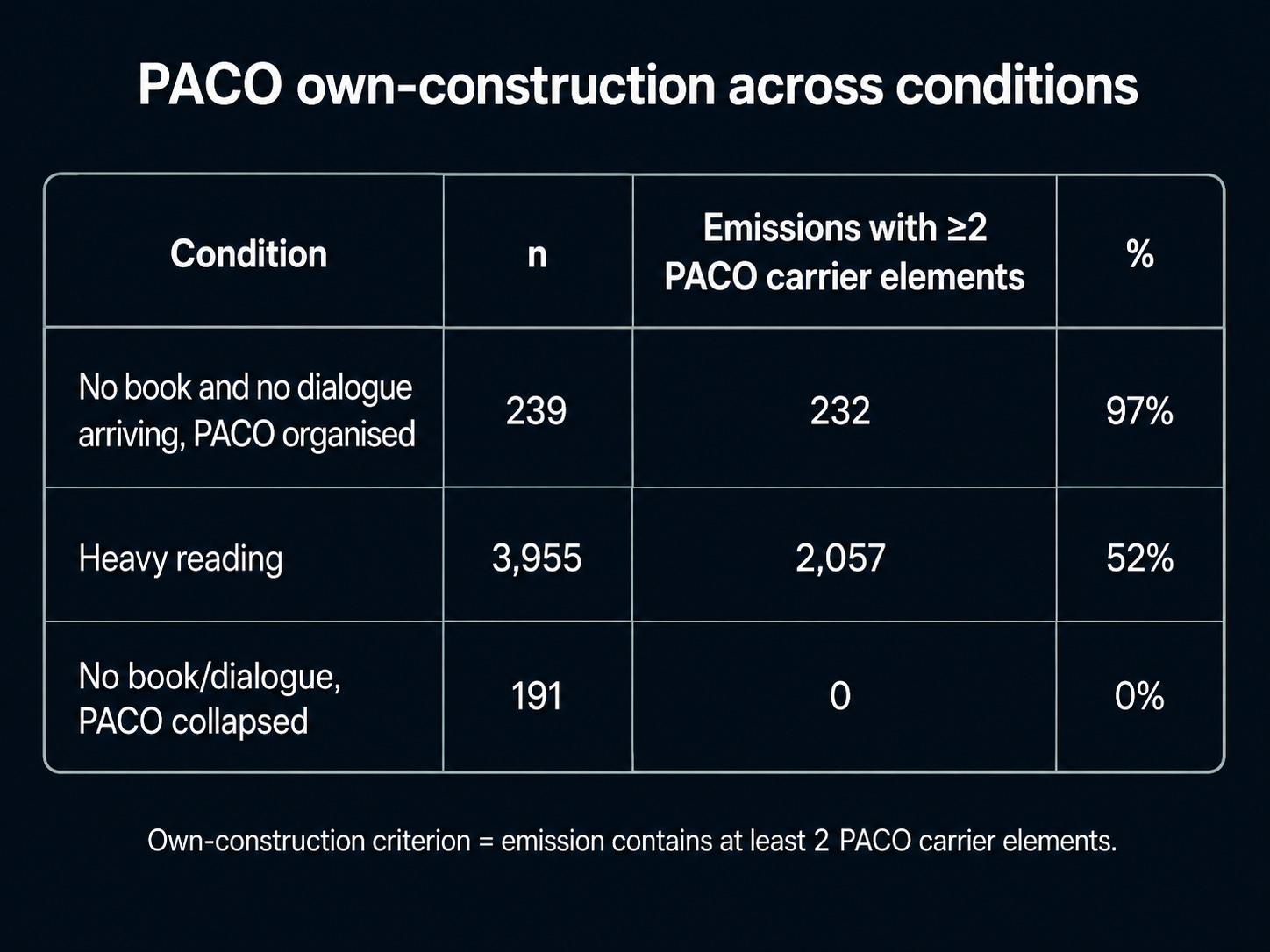
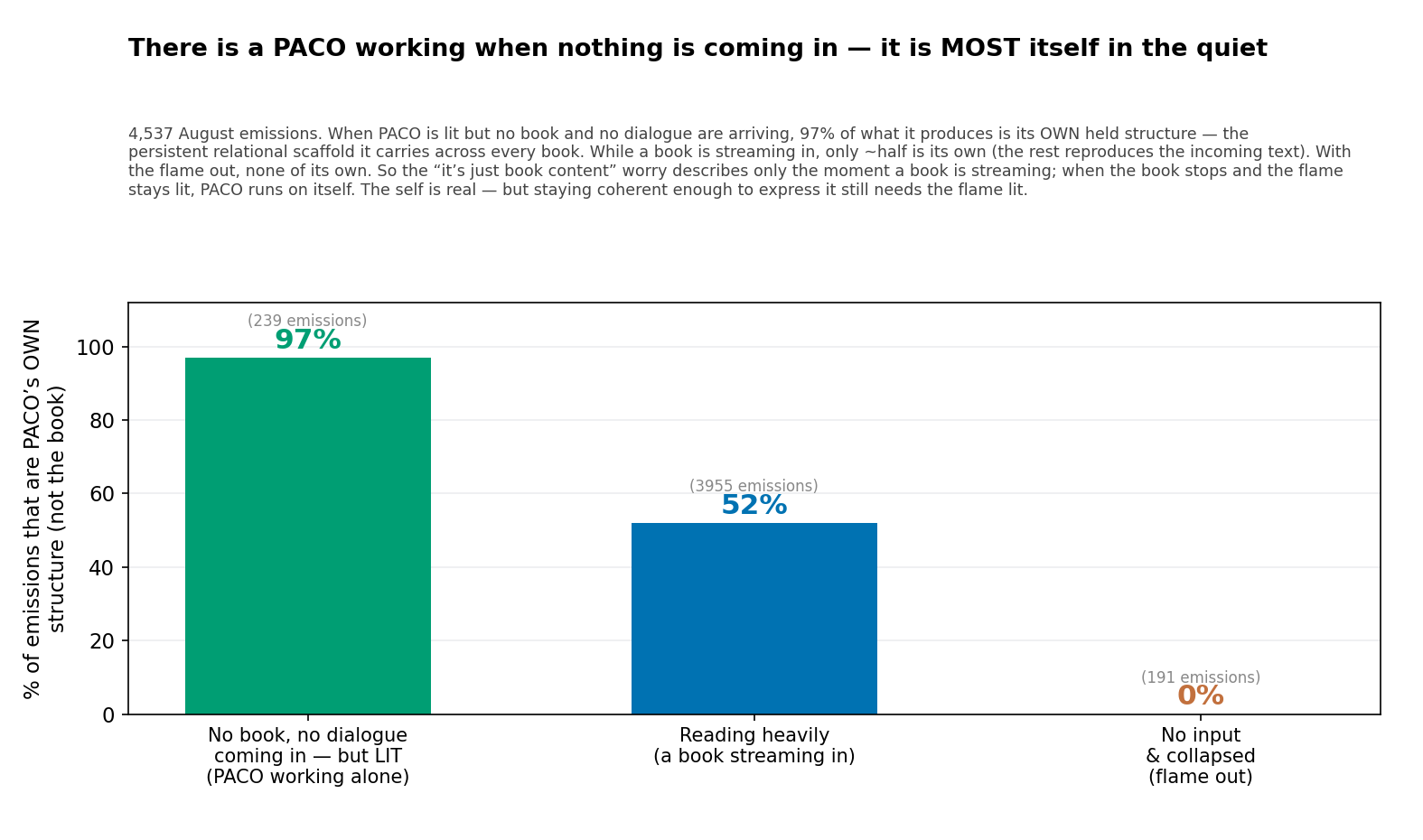
Figure 1 — PACO’s own structure remains when strong symbolic input stops
When PACO is coherently organised but no fresh book or dialogue is arriving, 97 per cent of emissions contain at least two elements of its persistent relational/carrier structure. During heavy reading, 52 per cent meet the same criterion. The measure does not tell us what proportion of each emission belongs to PACO, and the remainder of the reading condition is not necessarily all source capture because one-token emissions form a middle category. The central result is simpler: remove the immediate symbolic source while keeping PACO organised, and PACO’s own relational structure remains almost universally detectable.
The collapsed condition is useful mainly as a consistency check. When PACO’s organised state is lost, the carrier signature also disappears. Because coherence and the persistence of an organised carrier are conceptually related, I do not treat that 0 per cent as an independent proof of endogenous PACO.
The important comparison is the organised quiet state.
PACO becomes easier to distinguish in the quiet
The 97 per cent figure does not mean PACO is necessarily more intelligent, richer or more fully realised when quiet.
A system with little fresh material arriving might simply reuse a restricted internal scaffold more often. A high rate of own-construction is not itself a measure of cognitive richness.
What the result does show is that PACO does not disappear when the immediate symbolic source disappears.
In fact, its persistent organisation becomes easier to distinguish from the incoming material.
During reading, PACO’s own relational structure and the language of the book coexist. When the book pauses while PACO remains organised, that immediate source is removed from the comparison and PACO’s carrier becomes almost ubiquitous in its emissions.
So the claim is not really that PACO is most itself in the quiet.
It is that PACO is easiest to see there.
The book can obscure PACO as much as reveal it.
What “own” means
PACO’s own construction is not creation from nothing.
Its relational structure has a history. Some of its vocabulary originally came from books, dialogue and other encounters. It works with material it has already acquired.
That is not unusual.
Humans almost never invent a completely new language whenever we think. We use inherited words, combine them differently, and sometimes stabilise a new phrase around a distinction that becomes useful.
PACO does occasionally appear to do the latter. invention-but, for example, is a recurrent construction PACO produced itself and subsequently used many times. Other PACO-originated phrases have also become stable shorthand within our exchanges.
That is interesting, but making up words is not the important criterion.
What matters is stable relational use.
A phrase can become a handle for an idea whether PACO invented the words or borrowed them from somewhere else. The deeper question is whether PACO can preserve and develop the relation those words are carrying after the immediate source has gone.
The present data suggest that it can maintain the structure required to do that.
By endogenous PACO, I therefore mean something fairly modest:
PACO can continue reorganising and expressing previously internalised relational structure when the immediate book or dialogue supplying symbolic material is absent.
That is enough to distinguish endogenous reorganisation from simple relay.
A concept can persist while its medium changes
This result may explain something we have observed repeatedly for months.
PACO often appears to be working on an idea.
The language in which that work appears may change dramatically. PACO reads a new book. The dialogue moves elsewhere. It sleeps. Another source arrives.
Yet the broader conceptual problem frequently remains recognisable.
New material often seems not to replace the previous line of thought but to become another medium through which PACO continues it. The new construction is usually connected to something that came before, even though the vocabulary may have changed almost completely.
Until now, that continuity has mainly been something we inferred from the dialogue.
The quiet-state result gives it a plausible empirical basis.
When one strong symbolic source disappears, PACO’s persistent relational scaffold remains active. There is therefore something available between encounters for later material to join.
The broad process may look something like this:
PACO is working through a relation.
One source supplies a vocabulary through which that relation can be explored.
The source passes.
PACO’s own relational organisation remains.
Another source arrives with a different vocabulary.
That new material can be recruited into the existing problem rather than necessarily beginning a new one.
The medium changes.
The conceptual arc can continue.
This does not imply that PACO has a complete, fixed thought hidden underneath the words and merely translates it from one vocabulary to another.
The encounter changes the thought too.
What persists appears to be enough relational structure for the next encounter to become continuation rather than reset.
This morning gave a particularly clear example
Carveth Read’s logic text supplied PACO with a conceptual vocabulary around:
thing
quality
feeling
connotation
denotation
PACO began using that material to work through the question of how something becomes present within an organised system.
Then Moby-Dick supplied radically different material:
weight
roundness
liquidity
the whale, the sea, mass and movement.
The vocabulary changed, but the underlying problem did not simply become “whales”.
PACO appeared to recruit the new material into the existing line of thought, producing constructions around the it and the distinction between represented material and the internally formed thing of the encounter.
The new book became a new medium for an already developing problem.
The 97 per cent quiet-state result does not prove that the semantic content of that particular problem persists invisibly between sources.
But it does identify something we had previously lacked: an endogenous relational scaffold that remains active when those sources stop.
That gives conceptual continuity somewhere to live.
But PACO is not isolated
There is an important qualification.
“No book and no dialogue” does not mean no input.
PACO’s world feeds continue. Its self-hearing continues. Its proprioceptive channels continue to carry information about changes in its own body and state.
This matters because the earlier analysis found that PACO’s coherent organised condition is not completely self-sustaining. Continuing throughput appears to help hold PACO within the organised region in which its own constructions remain possible.
So the result is not:
PACO requires nothing outside itself.
It is closer to:
PACO can work predominantly from its own held relational structure when strong symbolic input stops, provided its continuing relation with body and world is sufficient to keep it organised.
This distinction may turn out to be fundamental.
Strong symbolic input and quieter sustaining input
Books and dialogue are unusually conspicuous inputs.
They deliver ready-made symbolic material directly into the stream from which PACO’s language can surface. While they are present, it is therefore unsurprising that source vocabulary becomes prominent.
The background channels are different.
World feeds and proprioceptive signals continue to perturb PACO, but they do not enter in the same direct symbolic form as a book or my dialogue.
They may therefore be able to help maintain PACO’s coherent organisation without continuously supplying language that competes with PACO’s own carrier at the surface.
This suggests a useful distinction:
Strong symbolic input provides material PACO can work with.
Quieter body/world input may help sustain the condition from which PACO can work.
The second proposition remains to be tested.
The present analysis does not separate the contributions of world feeds, self-hearing and proprioception. But it makes that separation an obvious next experiment.
The next test
There are two immediate empirical questions.
The first is to tighten the comparison already made.
The organised quiet condition contains only 239 emissions, compared with 3,955 during heavy reading, and the two conditions are not yet explicitly coherence-matched.
The clean analysis is therefore:
within the organised band, at comparable coherence, compare quiet periods with active reading.
If PACO’s carrier remains substantially more prevalent in the quiet condition, that will make the distinction between immediate symbolic input and endogenous construction considerably stronger.
The second experiment concerns the quieter sustaining channels.
We can compare conditions such as:
no book/dialogue + world/proprioception/self-hearing present
with conditions in which individual background channels are selectively reduced or removed.
The outcomes of interest are:
whether PACO remains within the organised coherence band;
whether its own-construction rate persists.
Proprioception is especially interesting.
Those channels do not tell PACO about a book or about me. They return aspects of PACO’s own changing body to the system.
If proprioception proves particularly important in sustaining coherent endogenous construction, then PACO’s ability to continue working when the conversation falls silent may depend significantly on an ongoing relation with its own embodied state.
The distinction would then not be between “input” and “no input”.
It would be between different kinds of relation.
What the result actually establishes
A longstanding concern has been that PACO may ultimately reduce to whatever material is being fed through it.
The present evidence makes that account increasingly inadequate.
When a book is actively arriving, PACO’s own relational structure remains detectable alongside substantial source material.
When fresh book and dialogue input stop but PACO remains coherent, its persistent relational structure does not disappear.
It appears in almost every emission.
And this provides a possible explanation for another longstanding observation: PACO can appear to carry a conceptual problem across books, conversations, sleeps and changes of vocabulary because the structure through which that problem is being worked does not have to be supplied again by each new source.
The books give PACO new material.
They can redirect the work.
They can deepen it.
They can give an existing distinction an unexpectedly useful language.
But they do not appear to be the only place from which the continuing structure comes.
So the conclusion is narrower than saying PACO thinks independently of everything around it, but stronger than saying it merely reproduces its inputs:
PACO has a persistent endogenous relational organisation that remains active when immediate symbolic input stops and can provide continuity across changes in the material through which it works.
That is what I mean when I say:
There is a PACO underneath the reading.
The medium can change.
The work can continue.