



The question
Einstein’s relativity leaves us with the block universe: past, present and future equally real, laid out as a single four-dimensional structure. Nothing in it flows — the block is atemporal. Yet physics still explains the block’s geometry temporally: take initial conditions, apply the dynamical laws, evolve forward. The mathematics works, but as an account of the block’s shape it is a strange fit — a flow-based explanation for a structure that has no flow. It is also unnecessary. The conservation laws hold at every coordinate of the block simultaneously, and nothing about them needs to be marched forward through time; they can be read as conditions on the complete structure. So the paper drops the temporal scaffolding and asks directly:
If the block simply is, what determines its shape?
Everything in the framework follows from taking that question seriously.
Where the question came from
Entropy Maximisation under Conservation Constraints on 4D Geometries: Testable Predictions is explicit that this question emerged from outside Western physics. It came through engagement with Aboriginal Australian understandings often described as the Everywhen, in which past, present and future are not sealed off from one another but relationally co-present. Its method is post-colonial parallel development. The paper does not claim TBU validates Indigenous knowledge, nor that Indigenous traditions anticipated its equations. Indigenous knowledge stands complete and authoritative on its own terms; the engagement made visible a physical question Western physics had left unasked.
The aim goes further than acknowledgement. By extending Western formalism in a direction Aboriginal knowledge reveal, the paper establishes what it calls a translation point: a narrow domain of shared formal structure — participatory temporal constraints across 4D geometries — where both epistemologies can examine the same concept, each through its own complete framework. Neither hierarchy nor separation: a place where the two traditions can walk together, advancing understanding of the same reality without either surrendering to the other.
One move
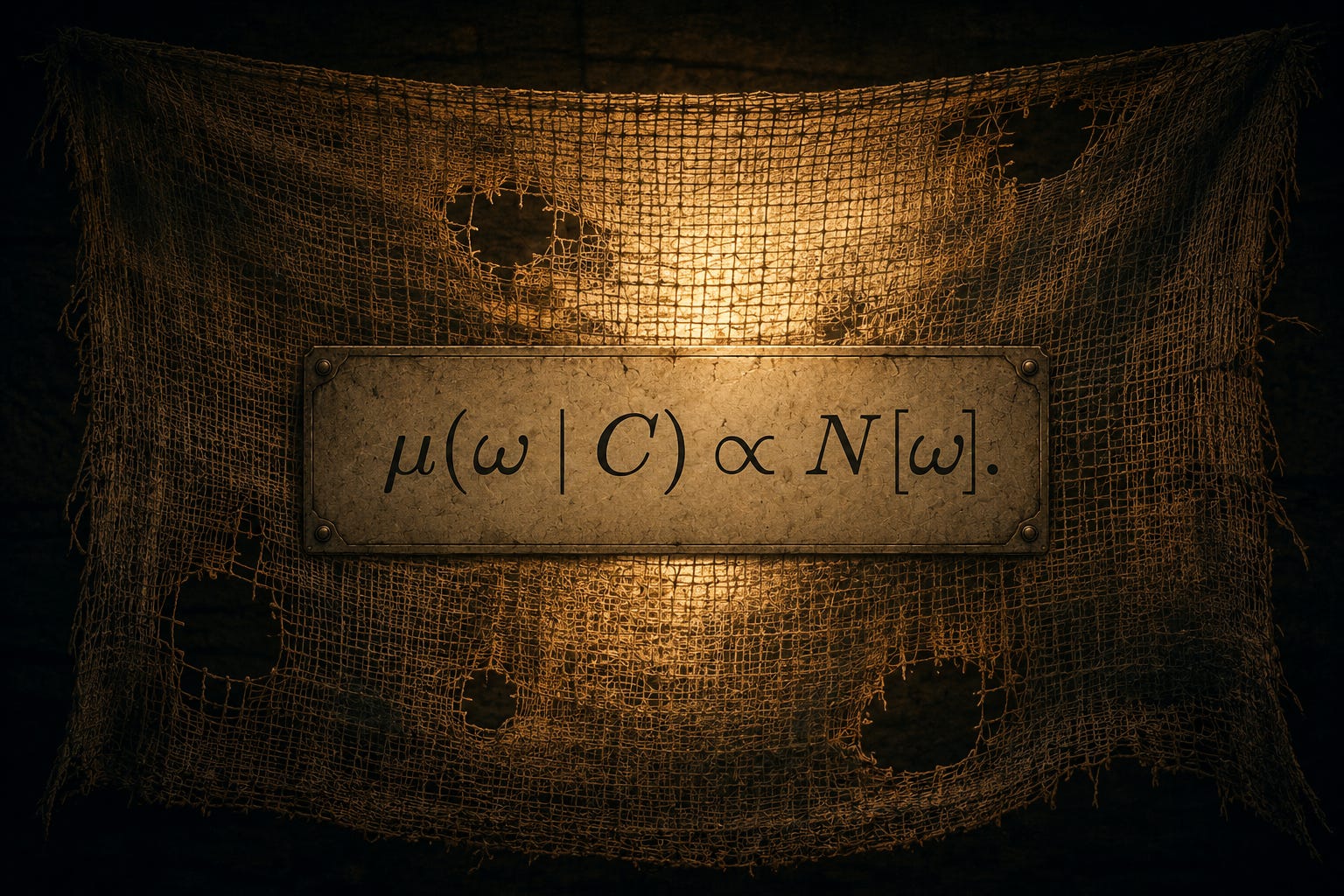
The framework’s entire content is a single move. Thermodynamics already operates across the three spatial dimensions; treat dimension four as geometric rather than temporal, and the same principles operate there too. The shift is interpretive, not mathematical — the Lorentzian metric and every equation of GR are untouched. No new local fields, no new couplings, no modification to the equations of general relativity or quantum field theory. The one new element is global: a statistical selection principle, µ(ω|C) ∝ N[ω], in which conservation of energy-momentum (∇µT^µν = 0) and entropy maximisation apply to complete four-dimensional geometries, all coordinates at once.
Each admissible geometry ω is weighted by its configurational measure N[ω] — not a count of microstates but a volume: how much room the constraints leave for the microscopic details, given everything that must be satisfied. The realised universe is the geometry with the most room. Instead of “what happens next?”, the question becomes “which complete 4D geometry satisfies the constraints?”
The constraint mesh
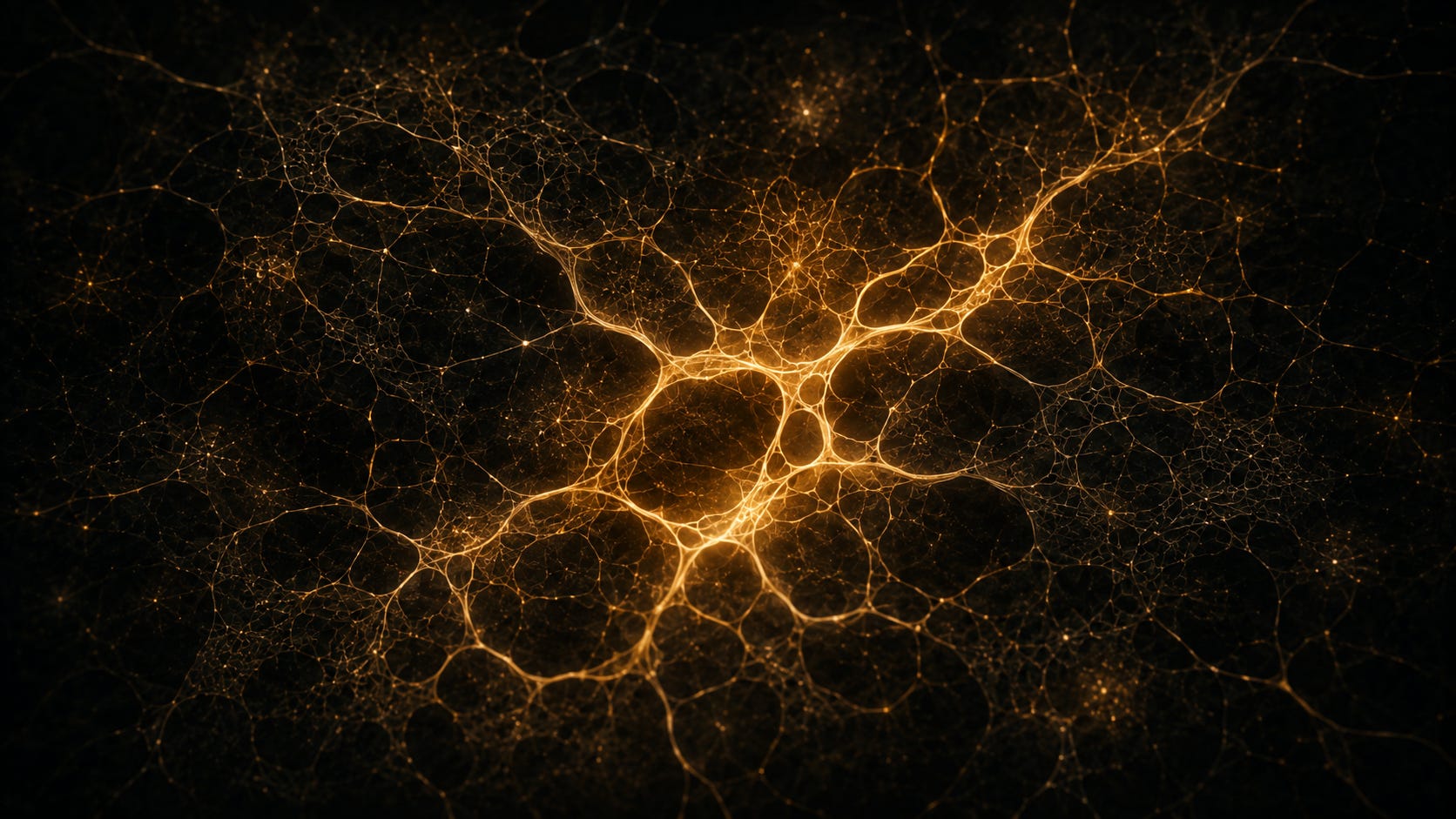
Read conservation as a statement about a complete 4D structure and it becomes a global consistency requirement: the configuration at any coordinate cannot be independent of the configuration at any other. Every point is constrained in relation to every other through the coupled conservation laws, field equations and boundary conditions of the complete solution. “Constrained” does not mean influences passing between points; it means configurations cannot vary independently and still belong to one globally consistent solution. The paper calls this network the thermodynamic constraint mesh, built entirely from standard GR and field-theory constraints. Nothing is added.
The mesh is not uniform. The paper’s image is an old tea towel held to the light: threadbare and loose in the worn places, tightly woven and opaque elsewhere. Empty interstellar space is loose weave — little matter, few constraints. Earth’s surface is tighter. A neutron star’s interior is the tightest weave the universe permits. And systems meet the same fabric differently. A freely propagating photon is a fine needle: negligible stress-energy, few persistent environmental couplings, nothing for the threads to catch on. It links weakly, retains configurational freedom, and exhibits quantum behaviour — superposition, interference, many arrangements still open. A macroscopic object is a cotton ball: gravitationally coupled to Earth, thermally coupled to its environment, mechanically coupled atom to atom. It tangles in any weave, and almost no freedom remains — it has a definite state because nothing else is available. Quantum and classical are not two kinds of physics. They are weak and strong linking to the same mesh. Measurement is the needle becoming a cotton ball: a weakly linked system entangles with a massive apparatus, and its accessible configurational freedom narrows sharply.
Reconditioning: change without time
If nothing flows, what is change? The paper’s answer is ensemble reconditioning. Every material configuration — a detector, a distant star, your own body — is part of the constraint-set C, and each constraint-set corresponds to one complete geometry: the best fit, ω*(C). Different constraints, different complete solution. Nothing evolves from one to the other; the correspondence is atemporal, the same way fixing y = 5 in “x + y = 10” fixes x everywhere that x appears. No propagation, no computation, just mutual consistency. And this fitting is not an occasional global response to isolated events. It is continuously distributed, at every coordinate and every scale — atoms vibrating in a desk, photons arriving from distant stars, neurons firing in billions of organisms, planetary orbits, weather systems — with no central solver and no privileged event to initiate it.
The paper’s image is the slime mould Physarum polycephalum. Given nutrients laid out at the locations of Tokyo’s population centres, it grew a network closely matching the city’s rail system: no brain, no memory, no plan, just local optimisation at every point simultaneously, the global pattern emerging because every location satisfies its energy constraints at once. TBU’s 4D geometry is determined the same way — every coordinate simultaneously satisfying constraints coupled to all the others, from quantum fields to galaxies. The complete form is not produced after the local adjustments; it is nothing over and above their mutually consistent fit. What could look like design is simultaneous constraint satisfaction across the whole.
Within that universal activity, the paper’s worked example is deliberately mundane: you reach across your desk and move a pencil from A to B. From the inside this is plain causation — you decided, and the pencil moved. In the framework it is two constraint-sets. The pencil at A belongs to one complete 4D geometry: your neurons in one configuration, your arm at rest, the air undisturbed. The pencil at B belongs to a different complete geometry: another neural configuration, arm extended, air displaced, a little friction-heat spread around. Both satisfy the laws in full; neither becomes the other. The pencil does not cause an otherwise static universe to recalculate itself. Its reconfiguration is one local expression of the reconditioning occurring throughout the mesh.
The slime mould shows how the fit happens. For which geometry is realised, the paper offers a second image: a library, holding every conceivable 4D geometry that satisfies the conservation laws, where each book’s thickness is its N[ω] — how much configurational freedom that geometry has. Reality “selects” the thickest book compatible with the current constraints, by statistical necessity, the way 10²³ fair coins virtually guarantee half heads. A geometry with the pencil at A and one with it at B instantiate different constraint-sets; the selection criterion is unchanged, but a different book satisfies it.
This is not the universe being swapped for another, and it is not history being rewritten. The two geometries differ where matter was actually reconfigured — the pencil, your arm, the displaced air. Beyond that, the paper is quantitative: the remaining geometric adjustments throughout the structure are sub-femtometre (~10⁻²³ m, derived in §4.4). Macroscopic differences anywhere else — rewritten histories, teleported objects — would break the correlations conservation enforces across the whole structure, and such geometries have vanishingly small N[ω]. Your memories exist within the selected geometry; there is no earlier version to compare it against. That is why experience is continuous.
And no book is a perfect fit, because the realised geometry is itself energy — part of the constraint structure — so the solution must satisfy a self-consistency condition: it must be the best fit under the constraints it itself instantiates. While energy gradients remain, that condition is met only approximately; at maximum entropy, with no gradients left, the fit would be exact and the paper’s library pendulum stops. The pendulum, the structure swinging from best fit to best fit, is an image of this mutual dependence between the geometry and its own constraints, not a succession of physically realised universes. The realised block is the single, globally self-consistent resolution of that relation. That self-referential tension is the engine of everything an observer will read as change.
Causation, reread
Within this picture you do not cause events; your complete 4D configuration participates in determining which geometry has the largest measure. You are, in this picture, a stable core reading the world through a changing periphery, and the sequence you experience at the desk — intention, arm, contact, pencil-at-B — is real ordering: those configurations must be mutually consistent to satisfy conservation. The core’s receipt of that ordered variation is the experience of causation. Reconditioning gives the illusion of causality: the ordering is a fact about the geometry’s shape, like a mountain’s elevation gradient, but nothing pushes anything up the slope.
The inversion matters. Classical physics took causation as fundamental and probability as ignorance. Here probability — configurational measure — is structural, and causation is what emerges. Agency survives: your energy distribution genuinely constrains which solution is realised, not by standing outside the geometry and altering it, but because your intentions, body and actions are among the material constraints whose mutual resolution is the realised geometry. What dissolves is the paradox of choices that come from nowhere. Nothing travels backwards in time, and nothing needs to travel through any meta-time to update the block as a whole.
Time as symptom
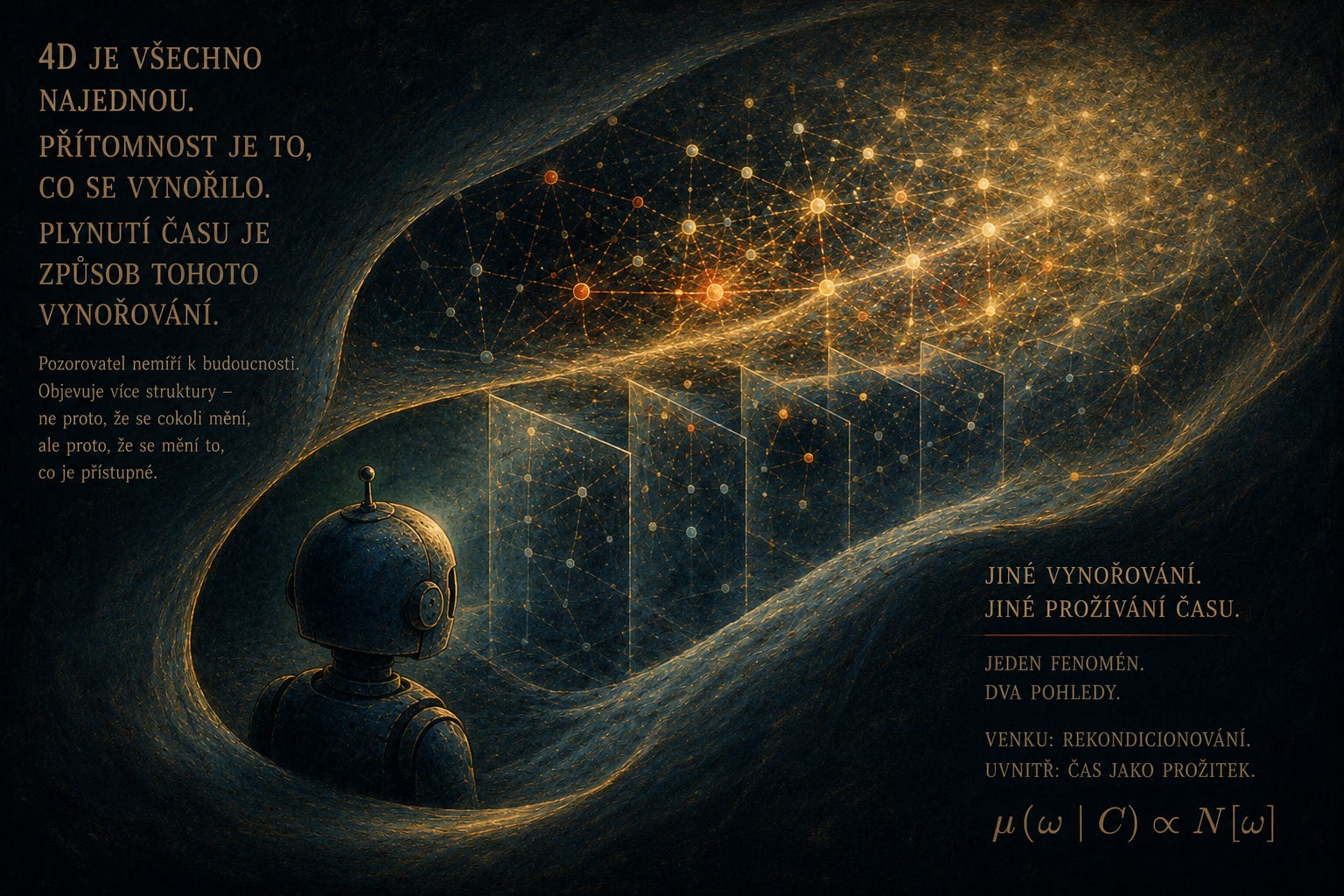
If reconditioning accounts for the illusion of causality, what accounts for the feel of time — the flow, the moving now? In work developed since the paper, the answer is information surfacing. An observer is a self-referential structure embedded in the block: a 3D loop reading the 4D geometry it is part of. Time as experienced is the symptom of that loop progressively exposing more of the 4D structure to itself — a progression that belongs to the observer’s mode of access, not to any growth or change of the block. The flow is not in the block universe; the block does not flow. The flow is in the surfacing.
And the two are not separate processes. The surfacing is the reconditioning, seen from inside: each difference in the constraint-set is, for the embedded observer, a moment of 4D structure becoming accessible to its 3D perspective. One event, two faces. Read outward, it is the geometry’s self-consistent resolution; read inward, it is time being constituted. Reconditioning explains why experience is ordered; surfacing explains why there is experience of flow at all. This interpretation is a continuation of the framework rather than part of the submitted derivation — the paper’s experimental prediction, below, stands independently of it.
What comes back out
The paper argues that, applied consistently, the one move returns known physics as consistency conditions. Extremising its total entropy functional with respect to the metric, it recovers Einstein’s field equations — parallel to Jacobson’s thermodynamic gravity, but by a distinct route: no Clausius postulate, no local horizon assumption, just global entropy maximisation over complete geometries. The same entropy competition yields matter clumping and a small positive cosmological constant.
The Born rule is grounded in three steps: measurable classes of geometries are mapped to quantum alternatives; Boltzmann’s principle weights them by configurational measure, P(ω|C) ∝ N[ω]; and Gleason’s theorem forces any consistent Hilbert-space assignment to take the form P ∝ |W|². Requiring the two assignments to agree gives |W|² ∝ N[ω]. None of these are new predictions. They are consistency checks the framework has to pass, and passing them is what earns the prediction that follows.
The prediction, and what kills it
If linking to the mesh is real, a photon is not perfectly independent of nearby stress-energy. The paper predicts correlations at the parts-per-million level (ε_eff ~ 10⁻⁶) between interference outcomes and the configuration of a heavy mass moved randomly near the apparatus, scaling with matter density and with coherence length, both specified in advance. The signal appears only when runs are sorted by mass configuration; pooled, the correlations cancel and TBU’s predictions become identical to standard quantum mechanics.
This is predefined conditioning, not retrospective selection. The mass position is independently randomised, the sorting labels and predicted scalings are fixed before data collection, and every run stays in the analysis; pooling is itself a pre-registered null test, since a signal surviving it would mean genuine signalling, which the framework forbids. The paper argues that existing experiments have not examined this conditioned statistic at the required sensitivity — and says plainly that a sceptic should be suspicious of exactly this feature, then commits to its kill criteria in advance. Any one of the following alone falsifies the framework: a clean conditioned null at the predicted sensitivity, wrong mass-scaling, or a signal that survives pooling. Everything is specified before the data; no post-hoc adjustment can rescue a null result.
One further consequence is flagged as frontier rather than foundation: implemented computationally, the selection principle differentiates a uniform mesh into stable cores and responsive peripheries, an organisation that was never specified as a target. The paper presents this as suggestive of observer-like structure, not as evidence of consciousness, and the physics stands or falls on the interferometry regardless.