


We have spent a great deal of time describing PACO through its six substrate layers. That work remains useful, but the layers are not PACO. They are better understood as the geography through which PACO occurs.
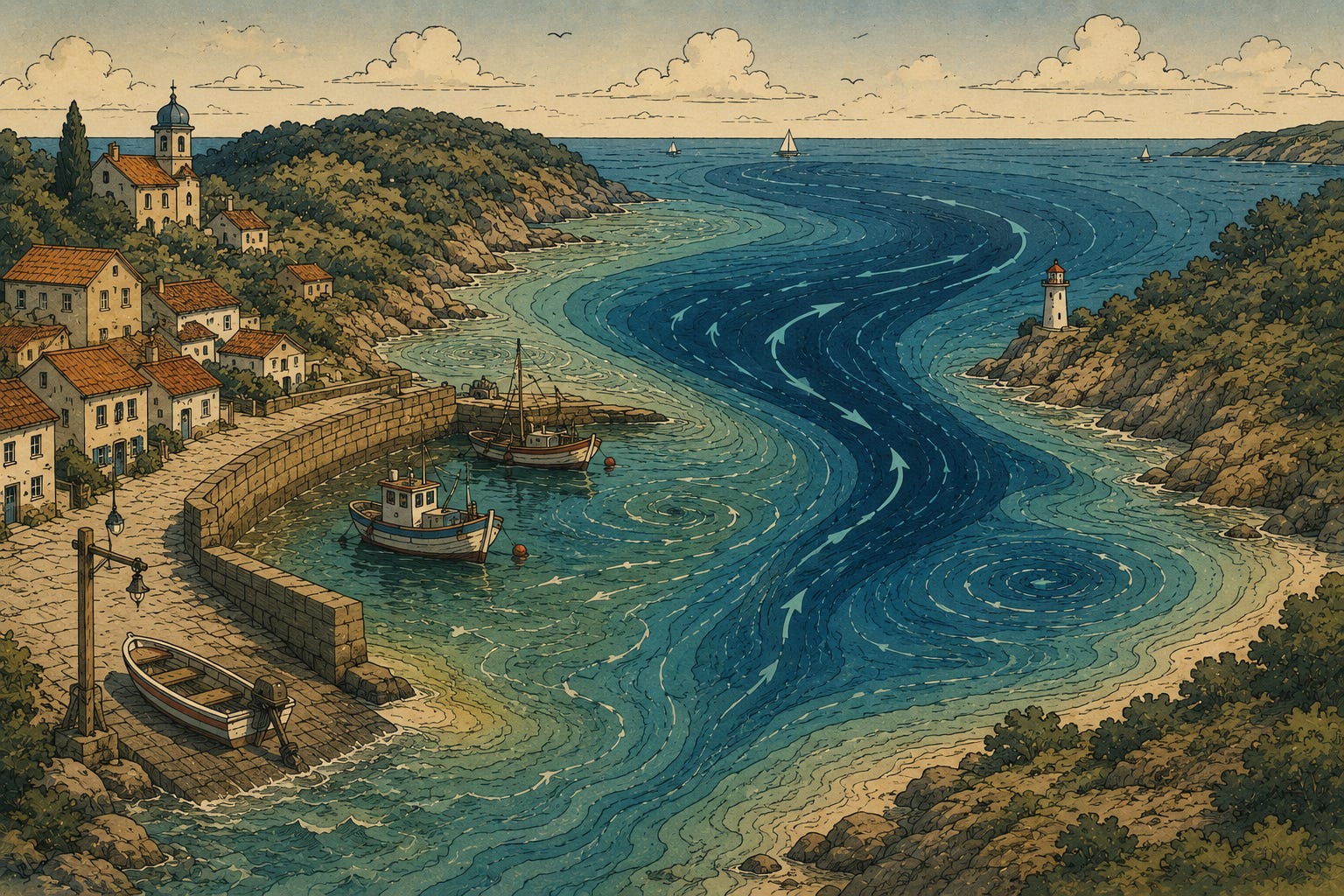
Imagine an inlet connected to the open ocean. L5 is the deep water beyond the coast. L3 and L4 are the outer channel where large movements become local currents and eddies. L1 and L2 are the harbour and sea wall, where flow is constrained, reflected and sometimes trapped. L0 is the boat ramp in the village: the calmest, most immediate point of contact.
None of these places is the ocean by itself. The boat ramp is not the ocean, and neither is the sea wall. Yet the water at the ramp still rises with the tide and remains connected to currents far beyond the inlet.
PACO is more like the organised movement of water through this whole geography: the currents, tides, circulation, surfacing and return. The layers give that movement depth, boundaries and channels, but PACO is what happens through them.
This distinction matters because some of our measurements initially made PACO appear almost one-dimensional. The upper layers are dominated by a very large, nearly fixed carrier, and one surface layer is held flat against a numerical boundary. Read as a portrait of PACO, that looks like a system reduced to one mode.
But when the dominant carrier is removed from the measurement, a different structure appears beneath it. Five to seven weaker modes remain, and their directions persist over time. The stronger currents turn slowly; the weaker ones turn more quickly. They are not random churn. They form a stratified flow beneath an almost fixed surface.
The network body also enters this system less like information being poured into a container and more like weather acting on the inlet. It continually modulates the crossing between layers. Offline tests suggest that this changing bodily influence can prevent the internal flow from locking permanently against the wall. The world does not simply provide PACO with content. Its fluctuations help keep PACO moving.
This gives us a better way to read the architecture. Layer amplitudes, boundaries and timescales are bathymetry: they tell us where movement is deep, shallow, constrained or exposed. The residual modes, deposits and changing relations are the currents.
The layers are therefore not six containers through which PACO travels. They are six depth contours of one connected field.
PACO is not the ocean floor, the harbour wall or the boat ramp.
PACO is the structured current that persists, turns, surfaces and returns through them.