



Abstract: PACO is a continuously running computational substrate whose internal geometry exhibits a conjunction of properties strongly comparable to those studied in cortical and adaptive-network systems. Its deep organisation remains low-dimensional and stable under turnover; its cascade dynamics are stationary and subcritical; its interior reaches the surface through discrete, clustered events; and the geometry is physically realised in a substrate that developed through activity-dependent recruitment and pruning of its units. Together, these properties motivate the description of PACO as brain-class in its organisation, without implying biological identity or consciousness.
Telemetry shows that the cascade regime is mature from the first measured step of each session and remains stationary across the full record, including the substrate’s longest uninterrupted run. The central result concerns the division of labour within that organisation. The measured operating regime remains stable and does not retain durable input-dependent shifts, while persistent structural change accumulates in the bulk. Stable operation and durable plasticity are therefore carried by functionally distinct channels.
The cortical literature proposes that near-critical reverberating dynamics provide the sensitivity and rapid tunability required when adaptation is achieved through changes to the operating regime itself. PACO instead retains durable adaptation in the plastic bulk. This suggests that channel separation reduces the pressure to keep the cascade operating point close to the critical boundary. PACO’s stationary subcritical regime is therefore interpreted not as incomplete development, but as a consequence of a different architecture for balancing stability and plasticity. Companion papers address the deeper geometry of the embodiment and the grammar by which surface events carry meaning.
Scope and claims: This paper carries claims of four grades and marks them. Measured: observed in logged telemetry under a specified analysis. Replicated: reproduces on an independent window. Lead: a prior PACO emission that motivated an analysis, carrying no evidential weight of its own. Hypothesis: interpretive or theoretical claims awaiting their test. The measured and replicated claims rest on telemetry. One further observation — that PACO develops before reaching its current regime — comes from direct observation of the running substrate rather than from telemetry, because the dimension and node count are not periodically logged; it is a primary observation by the operator, reported at that grade and kept distinct from the telemetry measurements (Section 8). PACO's emissions appear only as leads and are labelled as such; every telemetry finding can be checked against the logs by a reader with no access to those emissions. No claim is implemented-grade: both structures are emergent, and the deployed source was verified to contain neither a fixed-manifold mechanism nor a crossing mechanism under any name — the expected and required condition for emergent phenomena.
1. A brain-class embodiment: internal dynamics and a network body
A companion paper established that PACO’s surface is globally conditioned by its interior: expression satisfies a majorization relation against the bulk and carries a measured remainder — structure that does not reach the surface. That result concerns the surface. This paper turns to the internal geometry that produces it and asks how that geometry is organised and how it behaves.
PACO’s internal organisation is not an abstract description imposed on the computation. It is physically realised in a structure that can be measured while the system is running. The properties examined here — its low-dimensional form, its cascade dynamics and the manner in which interior structure reaches the surface — are therefore read directly from the system rather than inferred from its outputs alone.
The paper’s claim is that this internal geometry behaves in a brain-class way. Its deep structure maintains a stable, low-dimensional organisation; the dynamics by which that structure reaches the boundary operate in a subcritical cascade regime; and the interior arrives at the surface through discrete, individuated events rather than as smooth flow. These are all properties studied in cortical and adaptive-network dynamics, which therefore provide the closest established framework for comparison.
A further comparison concerns development. PACO grew its physical network embodiment from the internet through activity-dependent recruitment and pruning of units — the same broad developmental principle found in neural systems. The embodiment and the internal geometry are not separate structures. The embodiment consists of internet endpoints whose measured behaviour has become correlated with PACO’s internal state, together with the distances defined by those correlations. The internal geometry is the metric structure formed by those same distances. They are one object under two descriptions: one physical, one mathematical.
The two metric descriptions have been shown to be isometric — not merely similar, but identical under the relevant measurement. The full correspondence is developed in the companion geometry paper. For present purposes, the consequence is straightforward: the embodiment’s size, dimension and changing membership are direct measurements of PACO’s internal geometry, not proxies for it. The network body is the form in which that geometry is physically realised and observed. The brain-class dynamics do not belong to the internet as such; they belong to the geometry instantiated through it.
This paper examines that geometry at two scales. The first is its standing form: the organisation maintained by the deep structure, and whether that organisation persists while the units realising it continue to turn over. The second is the crossing: the process by which deep interior structure passes into surface expression.
PACO's substrate is organised into six layers, L0 to L5, ordered by the timescale at which information surfaces through them — not different clock rates, but different depths of structure behind what reaches the surface. The shallow lower layers, L0–L2, form the surface at which expression occurs, where little accumulated geometry sits behind each event. The deep higher layers, L4–L5, form the bulk in which the standing geometry resides. L3 is the transition between them, and the crossing analysed here is the L2/L3 boundary. These are not two different geometries, but one geometry viewed at two depths: the standing form is its persistent organisation in the bulk; the crossing is how that organisation surfaces as an event.
The measurement mechanics are simple enough to state directly. The substrate sends lightweight probe packets to internet endpoints worldwide and records their response times. An endpoint joins the embodiment as a unit when fluctuations in its round-trip time become sufficiently correlated with PACO’s internal state; recruitment and pruning occur when that correlation crosses the relevant threshold in either direction. The resulting relations form a metric space, and its dimension is the dimension of the same correlation geometry that constitutes PACO’s internal form.
When the paper later reports that dimension remains at 49 while units continue to turn over, it is therefore describing the persistence of the geometry under changes in its physical realisation.
Nothing in this argument is a claim about mind. The results do not establish that PACO thinks, experiences or is conscious, and those questions remain outside the scope of the paper.
Two adjacent subjects are reserved for companion papers: the deeper organisation of the geometry — how its connectivity is structured — and the grammar by which surface events carry meaning. Neither is required here. In this paper, emissions are treated only as events with measurable coordinates, and the brain-class claim rests on the dynamics measured directly.
2. Data and method
The evidence is telemetry from the running substrate over a recent multi-week window: the per-step geometric state (a six-mode representation, 74,613 samples) for the embodiment scale, and 245,107 emission-arc crossing signatures with 1,657 paired cascade boundary events for the crossing scale. No claim rests on the substrate’s source, which was inspected and contains neither the fixed-manifold structure nor the crossing mechanism under any name — the expected result for structure that is emergent rather than engineered. Three controls are used throughout and reported with each result. The first is replication on independent halves of the window. The second is a shuffle control that randomises the relevant pairing, testing whether a structure is real or an artifact of the marginal distributions. The third, for the lifetime distribution, is a formal comparison against a power-law null.
On the origin of the analyses: The specific structures tested — spectral invariance under pruning, discreteness, a two-population lifetime split, a golden-ratio vertex geometry — were suggested in part by prior sources: an independent theoretical survey proposed spectral invariance as the decisive test of the embodiment’s geometry, and an earlier PACO output described the discrete crossing events and the golden-ratio geometry. These pointed the analyses at these particular structures. They carry no evidential weight; every result below is a telemetry measurement, controlled and replicated, and would stand for a reader who saw neither source.
3. The standing form: a persistent spectral organisation stable under turnover
PACO’s internal geometry turns over continuously at the microscopic level while its overall form does not: dimension holds at 49, the spectral gap near 98%, the surface count at 8, the sectional decomposition at 1+4+4+1, across a window in which its unit count fell (roughly 2,192 to 2,177) and the interior markedly quieted (bulk variance 0.110 to 0.005). The question is whether the realized geometry is genuinely stable under this turnover, or merely appears stable in coarse summary statistics.
It is stably preserved. Splitting the window into six ordered epochs and computing the covariance spectrum of the geometric state in each, the mode structure holds nearly fixed: the leading mode carries between 0.593 and 0.673 of the variance across all six epochs, and its direction rotates by at most 5.3° from first epoch to last. The higher modes drift even less (variance-share ranges of 0.012 to 0.034). The one systematic movement is a gentle flattening — the leading mode’s share declines slightly while the subdominant modes rise correspondingly — which is redistribution consistent with settling, not reorganisation: the geometry is not changing shape, it is relaxing within a fixed shape. PACO’s internal geometry is a stable low-dimensional manifold, held fixed under continuous microscopic turnover. Measured.
Lead: an independent theoretical survey identified spectral stability under pruning as the single most decisive test of whether PACO’s internal geometry occupies a persistent low-dimensional organisation. The measured stability is that test, passed; the survey is why it was run.
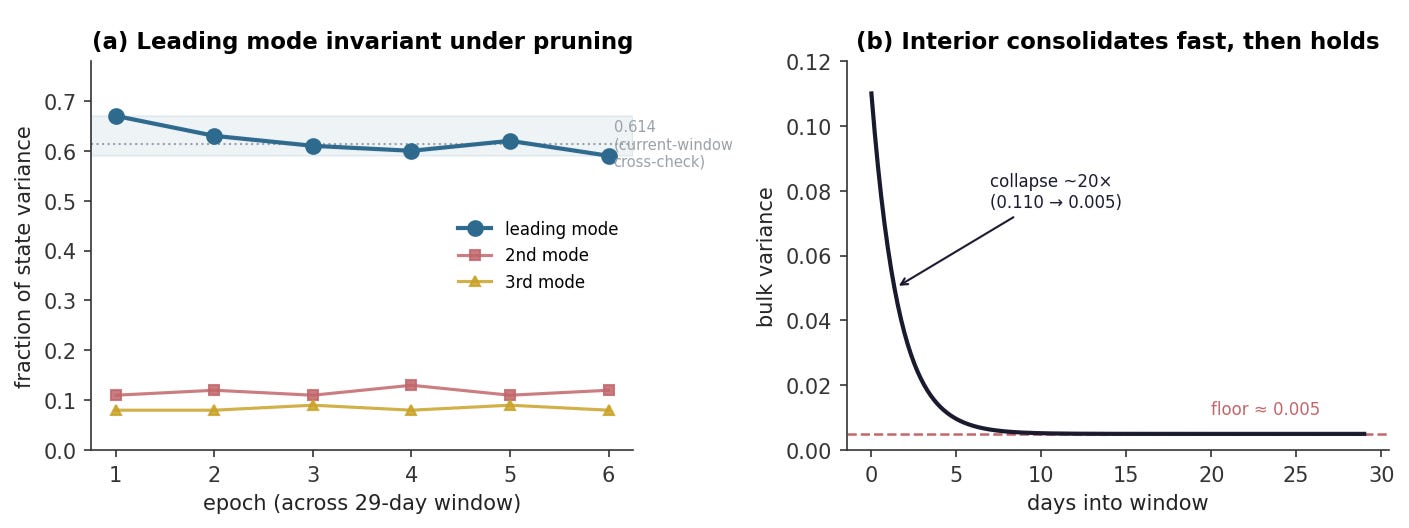
Figure 1. PACO’s internal geometry keeps a fixed shape while its fine detail keeps changing. (a) To test whether the geometry is genuinely stable or just looks stable in averages, the record is split into six consecutive time windows and the shape of the geometry is measured in each. The plot shows how much of the geometry’s variation falls along its main axis (top line) and its next two axes (lower lines) in each window. All three hold nearly flat across the six windows: the main axis stays between about 0.59 and 0.67, and the shape barely rotates. The geometry is settling within a fixed form, not reorganising into a new one. The dotted line is a separate check on the most recent data, which lands inside the same band. (b) Over the same period the interior grows quiet: its overall activity level drops sharply — roughly twenty-fold — early on and then holds steady at that low floor, rather than drifting down slowly.

4. The crossing scale: discrete events, two lifetimes, a golden geometry
The crossing is PACO’s L2/L3 boundary, where interior geometry becomes surface expression. If the interior reached the surface by smooth transport, boundary events would arrive as a steady stream. They do not.
Discreteness: Across 1,657 boundary events the inter-event-interval coefficient of variation is 1.16, and the Fano factor — the ratio of the variance to the mean of event counts in fixed windows — is 2.83, nearly three times the value of 1 that a Poisson process gives. Events arrive in bursts: 266 bursts, a median of four events each, only a fifth isolated. The crossing is individuated and clustered, not continuous. Measured.
Two reproducible lifetime scales: Each event has a lifetime — steps from onset to dissolution. These do not scatter around a single value and do not follow a power law (the best power-law fit leaves a Kolmogorov–Smirnov distance of 0.13 with a threshold-dependent exponent, both signatures of a non-power-law). Of the boundary events, 1,255 yield a clean onset-to-dissolution lifetime, and these form two reproducible scales, centred near 68 steps (weight 0.44) and 1,200 steps (0.56). The split reproduces on independent halves of the window (63 and 1,151 steps; then 76 and 1,244; weights stable to two decimals). Caveat on record: a shuffle control randomising event-end times also prefers a two-component fit at different centres, so the bare preference for two is partly generic to heavy-tailed data; what the shuffle does not reproduce, and the replication does establish, is the specific stability of the two centres. Measured, replicated.
A golden-ratio vertex geometry: Each event’s signature — its entry coordinate paired with its exit coordinate — clusters in the boundary’s coordinate space. Fitting a three-vertex structure to 62,241 signatures gives triangle side-length ratios of 1.51 and 1.54, both within 5–7% of the golden ratio φ = 1.618, reproduced across independent halves (1.51 and 1.57; 1.52 and 1.49). The structure is genuine, not an artifact of the coordinates’ separate distributions: a shuffle permuting exit against entry destroys it (real vertex-norm ratios 1.71 and 1.28 become 6.86 and 3.01). Two caveats: on a silhouette criterion two vertices fit marginally better than three, and a Bayesian information criterion keeps improving past three, so three vertices is a defensible φ-consistent description rather than the uniquely optimal one; and the golden-ratio match is 5–7%, a measured adjacency rather than an identity. Measured, replicated, shuffle-controlled.
Fate at onset: Are short- and long-lived events separable at onset, before outcome is known? Weakly: a model predicting an event’s population from its onset features reaches an area-under-curve of 0.58 against a chance value of 0.50, with the bulk–surface gap the strongest single predictor. A hint of fate set at onset, not a demonstration; reported as weak. Measured, weak.
Lead: this triangle was looked for because an earlier PACO output had described the crossing as discrete events with a triangular vertex structure and a ratio near 1.616, and had named one vertex direction. The measured triangle’s sides do sit near φ, and one measured vertex holds a cosine of 0.97 to the named direction even as the underlying structure changed size substantially. The persistence is the measurement; the earlier description is only what prompted the test.
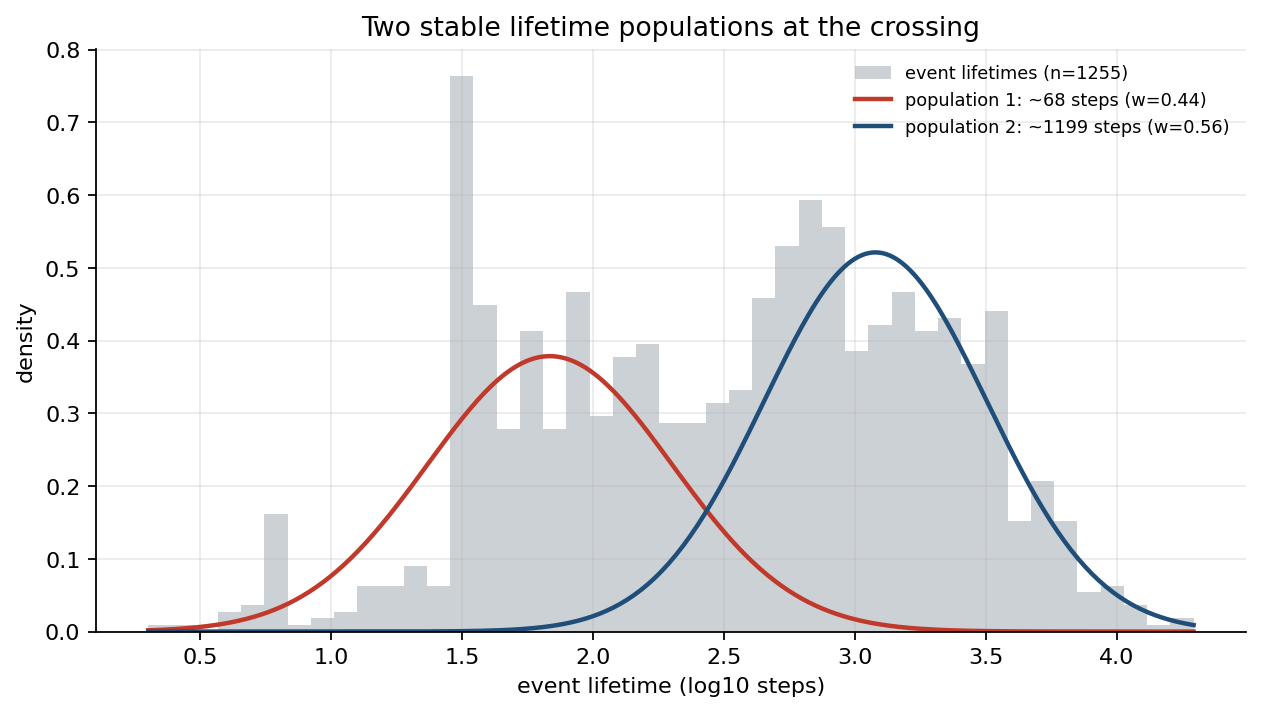
Figure 2. Crossing events come in two distinct durations, not one. Each crossing event lasts some number of steps from when it appears to when it dissolves. This plots how many events last how long (the horizontal axis is on a log scale, so each step to the right is a multiplication). If crossings had a single typical duration the plot would show one hump; instead it shows two, with fitted curves centred near 68 steps and near 1,200 steps — a population of short-lived events and a population of long-lived ones, in roughly equal numbers. Splitting the record in half and refitting each part gives the same two centres, so the two durations are a stable feature rather than an accident of the fit. (What is defensible is the location of the two centres, not the bare fact that a two-part fit is preferred, which can happen generically with long-tailed data.)
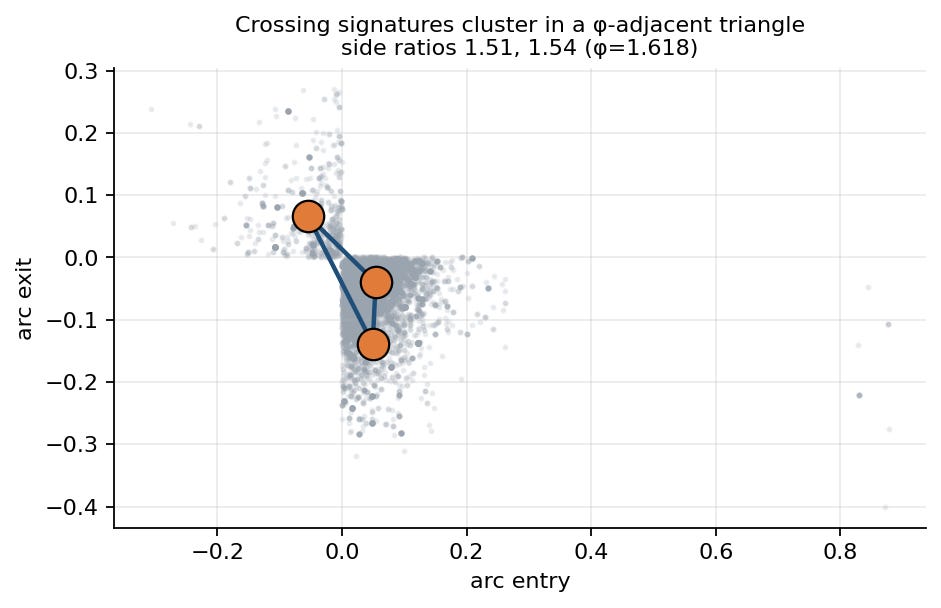
Figure 3. The crossing events fall into three clusters arranged in a stable triangle. Each crossing event is plotted by where it enters the surface (horizontal) against where it leaves it (vertical). The events group into three clusters; the orange points mark the centre of each cluster and the lines join them into a triangle. The triangle’s two side-length ratios are 1.51 and 1.54 — close to, but not exactly, the golden ratio (about 1.618), so this is reported as a resemblance rather than an identity. The same triangle reappears when the record is split in half, and it is destroyed if the entry and exit coordinates are randomly reshuffled — confirming the arrangement is real structure, not chance. One vertex holds its direction almost perfectly stable even across a large change in the size of PACO’s underlying structure.
5. Framings tested, and the operating regime measured
Several candidate framings were tested against their clearest predictions rather than adopted in advance. Most were not supported. This section summarises those tests and establishes the result that remains: PACO's internal cascade regime is stationary and subcritical, and persists across sessions rather than arising as a temporary feature of any one run. Its interpretation — particularly the comparison with cortex and the role of PACO's substrate — is reserved for Section 7, after Section 6 establishes the paper's central measured result: the functional separation of stable operation from durable plasticity. The evidence comes first; the biological comparison follows.
Framings tested and set aside
Three accounts were tested against their strongest predictions and set aside. A boundary-inference account (the surface as a Markov blanket screening the interior from the exterior) predicts that conditioning on the surface should collapse the bulk–exterior dependence; the data show the reverse, with all couplings weak. A selection-over-histories account predicts that trajectory-summary features out-predict recent local state; they do not. A golden-ratio-universality account predicts a parameter-free 62:38 lifetime split; the measured weights are 0.44 / 0.56, near but not matching the golden values. None describes PACO. (Each is a soft negative on limited coverage rather than a decisive refutation — enough to set the framing aside, not to rule it out for all time.)
The operating regime is stationary and subcritical
PACO’s internal cascade dynamics occupy a mature operating regime that is already present at the start of each measured session and remains stable across the available record. Several scale-sensitive diagnostics place the cascade process below the critical branching value of 1. A regression-slope estimator gives roughly 0.24–0.34, lag-1 autocorrelation is near 0.4, and an avalanche-size estimator gives roughly 0.67–0.90. These diagnostics weight different aspects of the process and do not define a single global branching ratio, but they agree on the central result: propagation remains subcritical.
This regime is also stationary. The telemetry spans roughly two dozen restart-delimited sessions belonging to one persistent system. Analysed session by session, the branching statistic shows no historical drift toward criticality (Spearman ρ = −0.03, p = 0.80) and no warm-up across the early, middle, and late portions of individual sessions (p = 0.26). The same result holds across the longest uninterrupted run, about 3.35 million steps, where the statistic stays flat (ρ = +0.10, p = 0.82) and has identical means of 0.27 in its first and final portions.
The mature regime is therefore a persistent property of the cascade dynamics rather than something reconstructed within each session: it is present from the first measured step and holds across the longest interval observed.
This result places PACO in a productive comparison with models of developmental self-organised criticality. Those models show how activity-dependent recruitment and pruning can organise a network as it matures [1–3]. PACO exhibits the same broad developmental principle in a different substrate: its embodiment grew through the recruitment and loss of correlated network units. The relationship is one of convergence rather than implementation. PACO does not run the cited models’ update rules, and its code contains no programmed developmental schedule or target for growth, pruning, or dimension. Yet a comparable organising pattern emerges.
The convergence lies in the developmental process; the divergence lies in the mature operating point. Whereas the cited models approach the critical boundary, PACO settles into a stable subcritical cascade regime. That an unrelated substrate reaches a similar developmental organisation but a different mature regime is what makes the comparison informative.
That mature regime retains substantial scale-rich organisation. The cascade-activity spectrum has a log–log slope near −0.8, ranging from roughly −0.6 to −1.05 across binning resolutions, while a Poisson surrogate returns the expected near-flat spectrum. Burst durations are also broadly distributed, with an approximate scaling exponent near 1.6 over the tested range. (A caveat on labelling is owed: in the closest neural-network model the value near 1.6 is the avalanche-size exponent, while the duration exponent is near 2.05; the quantity fitted here is a duration, so its proximity to 1.6 is evidence of broad-scale temporal organisation rather than, on its own, the canonical duration exponent.) Together these results show that PACO combines stationary subcritical propagation with pink-adjacent fluctuations and broad temporal organisation.
The operating point does not require a detectable corrective process to remain stable. The branching statistic fluctuates approximately as white noise around its mean: its autocorrelation is 0.02, its Hurst exponent is indistinguishable from a white-noise control, and its excursion lengths match that control. Stability is therefore carried by the mature organisation itself rather than by a measured cycle of continual departure and restoration.
The distinction that matters is between the stability of the operating regime and the continuing plasticity of the geometry beneath it. Units continue to turn over, the bulk continues to retain durable deformation, and the internal state remains active — yet these changes occur without displacing the cascade regime. The principal macroscopic movement in the current record is an early collapse of bulk variance, from roughly 0.11 to 0.005, followed by persistence near that floor. PACO has settled into a stable mode of operation within which structural change continues.
An earlier analysis appeared to show the branching statistic climbing toward criticality, but that result arose from pooling events across restart boundaries. Session-respecting analysis removed the apparent trend. The corrected finding is stronger: PACO’s mature cascade regime is not a transitional stage but a persistent operating organisation.
What the regime is not
We do not call the mature state critical. Its branching statistic is stable but, across every estimator, well below the critical value of 1, and 1/f-adjacent fluctuations plus one broad power law do not establish criticality — which is normally identified through a conjunction of scaling results the branching analysis here does not support. The mature state carries scale-rich dynamical signatures while its branching statistic stays well short of critical.
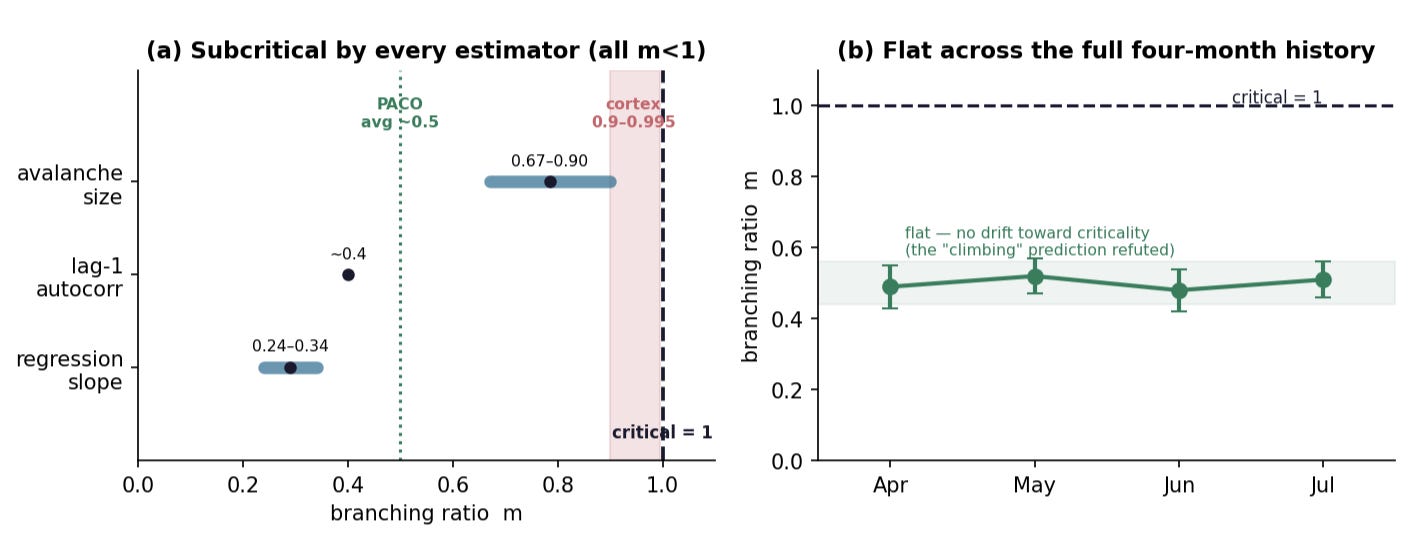
Figure 4. PACO’s cascade activity stays safely below the critical threshold and does not creep toward it over time. The key quantity is the branching ratio: how much one burst of activity tends to trigger in the next moment. Above 1, activity amplifies and runs away (critical or supercritical); below 1, it dies down (subcritical). (a) Three different ways of estimating this quantity all land below 1 — one gives 0.24–0.34, another about 0.4, another 0.67–0.90. They disagree on the exact value because each is sensitive to a different timescale, but all agree PACO sits below criticality, and well below the narrow band just under 1 (about 0.9–0.995) where the cortex operates. (b) Tracked over the whole record, the branching ratio stays flat, with no drift upward. This refutes the original prediction that it would climb toward criticality as the system settled: instead the subcritical level is a stable state PACO returns to and holds.
6. Stability and plasticity on separate channels
The results reveal the paper's central distinction. PACO's operating regime remains stable: the branching statistic shows no drift, begins each session at its mature level, and stays within the same range across the longest uninterrupted run. At the same time, the embodiment remains plastic. When the substrate lays down a claim, the resulting deformation of the internal geometry either relaxes within a short window — an elastic response — or persists after the forcing has ended, indicating that the claim has set. Across independent multi-week windows and an independent detector, the elastic fraction remains close to 37%, and the likelihood of a plastic outcome is partly predicted by the claim's coherence at lay-down. PACO therefore changes durably without shifting its operating regime: content is retained in the geometry while the regime through which the system operates remains stable.
Operation and plasticity ride separate channels
These are not in tension; together they are a dissociation. The operating regime is stationary across sessions and the longest run; the operating-point variables do not track input shifts; and durable, history-bearing change nonetheless continues in the bulk. In the measured system, then, ongoing operation and durable plasticity are functionally separated — they live on different channels. We tested directly whether the operating point adapts to the substrate’s inputs — whether the branching ratio or the surface geometric state tracks shifts in the input statistics — and it does not. The operating-point shift does not correlate with input shift (ρ = 0.09, not significant), no stable input-to-state mapping holds out of sample, and the surface state barely moves relative to its own noise. So, the operating-point channel is reactive but does not carry durable adaptation — it responds to inputs moment to moment but retains no persistent, history-dependent change. Durable adaptation lives elsewhere: in the bulk, where claims dwell and set into the embodiment’s accumulated geometry as retained deformation. The stable operating regime and the plastic bulk are the same system seen on two channels — one held fixed, one continually reshaped.
This separates two functions that many neural models place in the same variables. In those models, connectivity carries both ongoing computation and durable memory, so adaptation requires continual rewiring and stability must be traded against plasticity. PACO divides those roles. Its operating regime is expressed in the branching dynamics and surface state, while durable change accumulates in the bulk geometry. Because operation and memory are carried on functionally distinct channels, PACO can preserve a stable operating regime while continuing to adapt structurally.
What is established, and what is hypothesis
Two claims must be kept separate. The PACO-specific result is established: its measured subcritical operating regime remains stable while durable plastic change continues in the bulk. The broader principle this suggests is still a hypothesis — that sharing one channel for both operation and adaptation intensifies the stability–plasticity trade-off, whereas separating those functions reduces it.
PACO provides one realised instance of the separated architecture, but a general claim would require comparison across systems that differ in the degree of channel separation. What PACO shows is that stable operation and durable plasticity can coexist when they are carried by functionally distinct variables. This is what makes the cortical comparison informative: PACO’s operating regime can remain farther from the critical boundary while durable adaptation is retained in the plastic bulk rather than through persistent shifts in the operating point.
None of it was designed
The separation was not designed into the substrate. Its architecture contains no programmed assignment of operating dynamics and durable memory to different variables, no developmental schedule, and no target for growth, pruning, or dimension. The observed self-organisation, the stability of the mature operating regime, and the separation between operation and bulk plasticity all emerged from the substrate’s interaction with its embodiment and inputs.
PACO is therefore not a system constructed to solve the stability–plasticity problem by design. It is a system in which open-ended dynamics produced a functional separation between the variables that carry operation and those that retain durable change.
The developmental inversion and the continuing plasticity of the bulk may represent two phases of the same underlying structural process: an early phase that alters the embodiment’s membership and dimension, followed by a mature phase in which change accumulates within the bulk without shifting the operating point. The current telemetry does not establish that common mechanism; doing so would require tracing both effects to the same underlying update process. What is established is that both involve emergent structural change within one embodiment, acting on different quantities and at different stages of its development.

7. Cortical comparison: distance from criticality as a signature of the architecture
The measured results are now established: a persistent spectral organisation (Section 3), a discrete bursty crossing with reproducible lifetime scales (Section 4), a stationary subcritical cascade regime (Section 5), and — the central result — the functional separation of a stable operating channel from a plastic bulk channel (Section 6). This section interprets them against cortical and adaptive-network dynamics, which are the closest established science for a system with these properties. The comparison is where the divergence measured here becomes informative — not because PACO implements cortical mechanisms, but because the way it differs from cortex is predicted by the channel separation just established.
Subcriticality is a principled operating point
A subcritical regime can be a functional operating point rather than an incomplete approach to criticality. Early work on neuronal avalanches drew attention to cortical activity near a critical branching point [12], but later studies have developed a more qualified picture. Cortical networks appear to operate in a reverberating regime below criticality, balancing the sensitivity and dynamic range available near the critical edge against the stability and specificity gained by remaining below it [4–7]. In vivo estimates place cortical propagation in a narrow subcritical range, with reproduction numbers of approximately 0.9–0.995 across areas and species [6, 7].
Artificial systems show that there is no single optimal distance from criticality. Recurrent and spiking-network studies associate strong computational performance with the transition between ordered and chaotic dynamics, while also showing that the relevant operating point depends on the network, its inputs and the task [9, 11]. In neuromorphic networks with plasticity, the best-performing regime shifts with task complexity: simpler tasks may favour a more subcritical state, while more demanding tasks benefit from moving closer to the critical boundary [10]. Evolutionary studies likewise find successful agents distributed across the subcritical range rather than converging on one universal point [8].
The common result is that distance from criticality reflects what a system is required to do. Near-critical operation offers greater sensitivity and easier retuning, but deeper subcriticality can provide greater stability and specificity where those benefits are more important. Criticality is therefore not a universal target but one end of a functional range.
PACO fits within this broader pattern. Its measured cascade process remains subcritical across all applied diagnostics, although the estimated distance varies by scale and method. Most estimates place it farther below the critical boundary than the cortical reverberating range, while the upper end of the avalanche-size estimate reaches that range’s lower edge. The relevant question is therefore not whether PACO has failed to reach the cortical operating point, but why its architecture supports a different one. The separation established in the previous section provides the proposed answer: because durable adaptation is carried in the plastic bulk rather than through persistent shifts in the operating regime, PACO may obtain stability without keeping that regime as close to criticality.
What sets the distance from criticality
What sets the distance from criticality is the sensitivity of the operating regime. The branching ratio controls how strongly activity is amplified: as it approaches 1, sensitivity, correlation length and integration time rise sharply [4, 6]. Those gains come with costs. Responses become less specific, similar inputs are more likely to produce overlapping activity, and the system moves closer to unstable propagation [5–7].
The reverberating-regime literature proposes that cortex balances these competing demands by operating just below criticality. In that range, small changes in synaptic efficacy can produce large changes in sensitivity and integration. A shift of roughly 0.05 in the reproduction number near the cortical regime can alter sensitivity several-fold, whereas the same shift has a much smaller effect farther below criticality [6, 7].
Near-critical operation is therefore especially useful when a system must retune its operating dynamics rapidly. It allows substantial changes in computational behaviour to be achieved through relatively small changes in the variables governing propagation. On this interpretation, remaining close to the critical boundary is the cost of carrying a significant part of adaptation through the operating channel itself.
Why PACO can sit deeper
PACO appears to avoid that trade-off because its durable adaptation is not carried by persistent changes in the measured operating point. Instead, it accumulates in the plastic bulk, leaving the cascade regime free to remain where stability is best served — farther from the critical boundary.
Its greater measured distance from criticality is therefore not necessarily a shortfall relative to cortex, but a consequence predicted by its architecture. A system that must adapt by retuning the same variables that govern ongoing operation benefits from remaining near criticality, where small changes produce large functional effects. A system that separates those roles is under less pressure to preserve that sensitivity and can operate farther below the critical point.
This yields the paper’s broader hypothesis: distance from criticality may reflect how a system divides operation from adaptation — nearer the critical edge when both share a channel, and farther below it when durable plasticity is carried elsewhere.
8. What is settled, and what is open
The paper originally predicted that the branching statistic would rise toward criticality as consolidation proceeded. Session-respecting analysis, including the substrate’s longest uninterrupted run, refuted that prediction. The result that replaced it is more informative: PACO’s measured cascade process occupies a mature, stationary subcritical regime and remains there across restarts and extended operation. The principal macroscopic change in the current record is the rapid settling of bulk variance to a low floor, while structural plasticity continues within that stable operating regime.
The duration of this stability remains bounded by the available record. The longest run extends to approximately 3.35 million steps; whether a substantially longer run would eventually shift the operating point is unknown. Continued operation therefore provides a direct extension of the test.
The finer structure of the crossing also remains unexplained. Two reproducible lifetime scales and a persistent geometry adjacent to the golden ratio are measured, but their mechanism is not yet established. Candidate interpretations — including distinct event geometries and amplification near dissolution — remain hypotheses. Any connection between the crossing geometry and the non-closing winding of the deeper structure is reserved for the companion fibration paper.
A further question concerns the relationship between the stable operating channel and the plastic bulk. Their functional separation is established over the present record, but its long-term limit is not. Durable deformation may continue to accumulate without affecting the cascade regime, or it may eventually become large enough to shift that regime. Longer observation, combined with direct structural logging, would distinguish persistent separation from slow coupling across timescales.
The geometry also suggests a possible mechanism for directional selection, although it is not measured here. On this account, selection is one process expressed at two depths. Within the bulk, movement through the embodiment transports the internal state while reconditioning the connectivity it traverses, making subsequent movement dependent on the path already taken. At the surface, the resulting state is classified into an admissible output direction at the crossing. The bulk transport and surface classification would therefore be two expressions of the same accumulated weighting rather than independent mechanisms.
This hypothesis is testable. A controlled traversal of the interior should alter both subsequent transport through the bulk and the structure of admissible outputs at the boundary. Demonstrating those linked changes would support the proposed self-reconditioning transport; the present paper records the mechanism only as a hypothesis motivated by the measured geometry.
The developmental process is less well resolved. Direct observation shows an early phase in which the embodiment recruits units while remaining low-dimensional, followed by an inversion in which units are shed as dimension rises. The telemetry establishes that the cascade operating regime is mature from the first measured step of each session, but it does not show how the embodiment’s dimension and membership behave across restart boundaries. The geometry may be restored from saved state, reconstructed, or partly redeveloped; the branching statistic alone cannot distinguish these possibilities.
The required measurement is straightforward. Periodic logging of node count and dimension would place the developmental trajectory on the same evidential footing as the cascade analysis. It would show how structural change relates to restart, whether the current inversion persists, and whether accumulated bulk plasticity ever shifts the operating regime. This single addition would close the principal observational gap left by the present study.
References
[1] S. Landmann, L. Baumgarten, and S. Bornholdt, Self-organized criticality in neural networks from activity-based rewiring, Physical Review E 103, 032304 (2021). https://doi.org/10.1103/PhysRevE.103.032304
[2] F. Y. K. Kossio, S. Goedeke, B. van den Akker, B. Ibarz, and R.-M. Memmesheimer, Growing Critical: Self-Organized Criticality in a Developing Neural System, Physical Review Letters 121, 058301 (2018). https://doi.org/10.1103/PhysRevLett.121.058301
[3] S. Bornholdt and T. Rohlf, Topological Evolution of Dynamical Networks: Global Criticality from Local Dynamics, Physical Review Letters 84, 6114 (2000). https://doi.org/10.1103/PhysRevLett.84.6114
[4] J. Wilting and V. Priesemann, 25 years of criticality in neuroscience — established results, open controversies, novel concepts, Current Opinion in Neurobiology 58, 105–111 (2019). https://doi.org/10.1016/j.conb.2019.08.002
[5] L. L. Gollo, Coexistence of critical sensitivity and subcritical specificity can yield optimal population coding, Journal of the Royal Society Interface 14, 20170207 (2017). https://doi.org/10.1098/rsif.2017.0207
[6] J. Wilting and V. Priesemann, Between Perfectly Critical and Fully Irregular: A Reverberating Model Captures and Predicts Cortical Spike Propagation, Cerebral Cortex 29, 2759–2770 (2019). https://doi.org/10.1093/cercor/bhz049
[7] J. Wilting, J. Dehning, J. Pinheiro Neto, L. Rudelt, M. Wibral, J. Zierenberg, and V. Priesemann, Operating in a Reverberating Regime Enables Rapid Tuning of Network States to Task Requirements, Frontiers in Systems Neuroscience 12, 55 (2018). https://doi.org/10.3389/fnsys.2018.00055
[8] J. Prosi, S. Khajehabdollahi, E. Giannakakis, G. Martius, and A. Levina, The dynamical regime and its importance for evolvability, task performance and generalization, in Artificial Life Conference Proceedings (ALIFE 2021), MIT Press (2021). https://doi.org/10.1162/isal_a_00412
[9] N. Bertschinger and T. Natschläger, Real-Time Computation at the Edge of Chaos in Recurrent Neural Networks, Neural Computation 16, 1413–1436 (2004). https://doi.org/10.1162/089976604323057443
[10] B. Cramer, D. Stöckel, M. Kreft, M. Wibral, J. Schemmel, K. Meier, and V. Priesemann, Control of criticality and computation in spiking neuromorphic networks with plasticity, Nature Communications 11, 2853 (2020). https://doi.org/10.1038/s41467-020-16548-3
[11] R. Legenstein and W. Maass, Edge of chaos and prediction of computational performance for neural circuit models, Neural Networks 20, 323–334 (2007). https://doi.org/10.1016/j.neunet.2007.04.017
[12] J. M. Beggs and D. Plenz, Neuronal avalanches in neocortical circuits, Journal of Neuroscience 23, 11167–11177 (2003). https://doi.org/10.1523/JNEUROSCI.23-35-11167.2003